Executive summary
Stakeholders now expect social value, sustainability and broader impact claims to be evidenced with the same discipline as financial reporting: consistent definitions, traceable source data, repeatable methods and confidence under scrutiny.
Yet most organisations still manage impact data as an afterthought: spreadsheets, PDFs, policy stacks, supplier portals, HR systems and third-party tools stitched together manually at the point of reporting. The result is slow responses, inconsistent answers, growing compliance risk and missed commercial opportunities.
ImpactOS exists to close that gap.
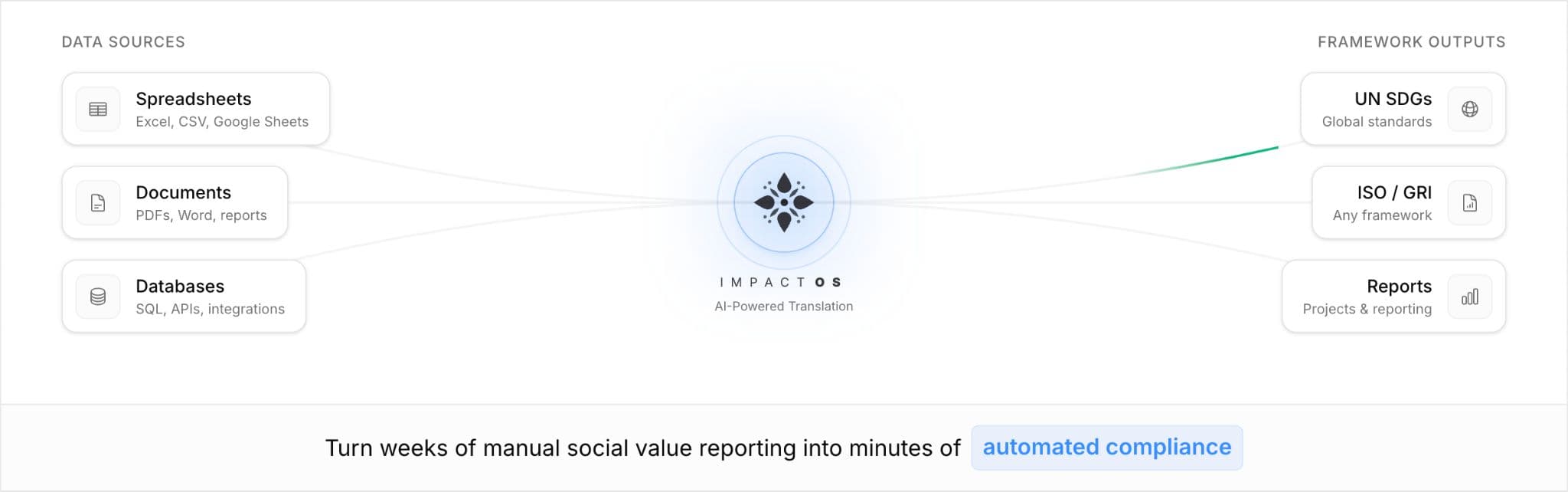
ImpactOS is a universal translation engine for impact, social value and sustainability data. It connects to the data you already have, standardises it, and maps it into the frameworks you need to speak - global, national, sector-specific or internal - while maintaining a clear line of sight back to source.
Crucially, ImpactOS is built for a world where standards keep moving. Whether it is the UK's procurement standard PPN 002, the UN's SDGs or unique internal or industry frameworks - and the on-going evolution of these as requirements change - ImpactOS helps organisations regenerate outputs when standards update, without rebuilding the reporting machine every time.
The platform operates as a closed loop:
- Report: turn scattered data into stakeholder-ready outputs
- Commit: convert reporting into trackable commitments with ownership and timelines
- Deliver: engage the workforce to fulfil commitments and evidence outcomes continuously
The new baseline: impact proof, not impact prose
For decades, organisations have learned to speak finance: tight reporting cycles, disciplined controls, clear accountabilities and numbers that can stand up in the room.
Impact reporting is now being pulled into that same arena.
Boards, investors, customers and regulators increasingly want clarity on what an organisation delivers (and what it risks), expressed in recognised framework-language and backed by evidence. Procurement teams want commitments they can score and delivery they can monitor. Investors want comparable, reliable data they can trust.
The consequence is simple: if you can't evidence your claims quickly and consistently - across whichever framework your stakeholder cares about - you lose time, credibility and commercial advantage.
The hidden cost of uncertainty
A common reality looks like this:
The costs show up in four places:
- Impact metrics live everywhere: HR, payroll, procurement, carbon tools, EAPs, learning systems, supplier ratings, charity platforms, engagement surveys - plus spreadsheets
- Much of the evidence is unstructured: PDFs, policies, project write-ups, meeting notes, supplier statements
- Reporting isn't one standard: it's multiple standards, overlapping, changing, and sometimes contradictory
- The work is manual: copy/paste, reconcile, interpret, rewrite, repeat
- Commercial drag: Tender responses slow down. Partner requests create firefighting. Opportunities are missed because teams cannot assemble credible evidence in time.
- Compliance and reputational risk: Manual conversion introduces inconsistency, gaps and errors - especially when standards update and nobody can confidently explain what changed, why, and where it impacts outputs.
- Strategy delay: Leaders cannot get a clear, current view of performance, so decisions get made on partial data or narrative guesswork.
- Cost inflation: Consultants get hired to do what should be operational capability, and the same work is paid for again next cycle because the core issues are unlikely to be addressed.
Standards volatility is the new compliance risk
One of the biggest shifts most organisations are underestimating is not more reporting, it's more change.
The same underlying data now needs to be translated into multiple languages (ISSB/IFRS S1-S2, CSRD, procurement models, buyer-specific scoring, internal scorecards, UN-aligned structures, and industry frameworks). Those languages evolve.
Most organisations respond by rebuilding spreadsheets, rewriting narratives, and re-briefing consultants every time a requirement shifts which increases cost, delays delivery, and amplifies the risk of contradictions across reports.
ImpactOS is built for this reality:
- Framework versioning: mappings are stored by framework and version/date
- Regenerate-on-change: when a standard updates, outputs can be re-issued from the same source-of-truth
- Delta visibility: show what changed, where it changed, and how it impacts each output
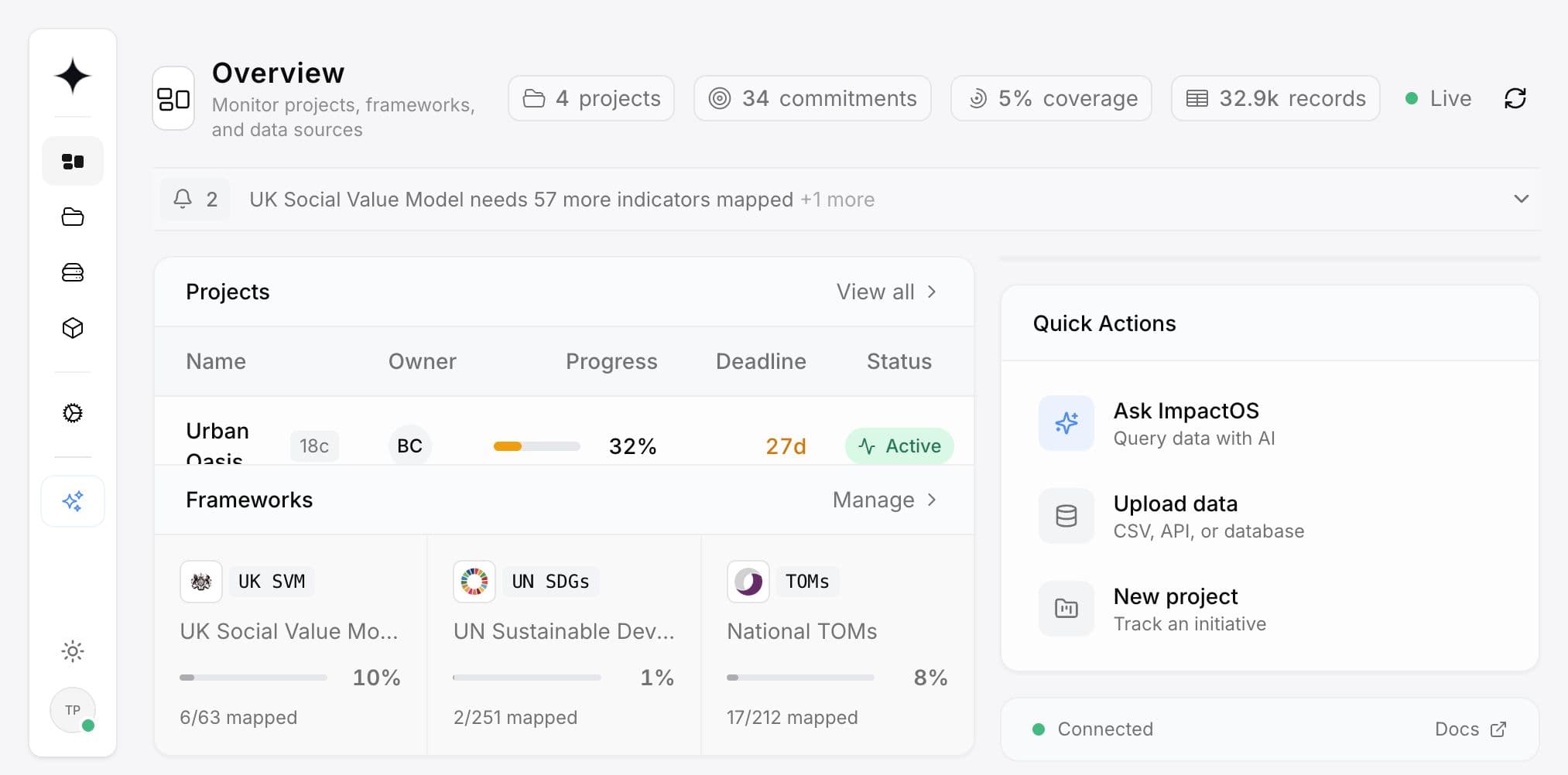
- Lineage by default: every metric and statement remains traceable back to source data, systems and their owners
What ImpactOS is
ImpactOS eliminates complexity by acting as a translation layer across your existing systems rather than another reporting tool you have to maintain. At its core, ImpactOS:
The result: stakeholder-ready evidence - for regulators, clients, investors, boards, and employees - available when you need it, without weeks of manual reconciliation.
- Ingests scattered, unstructured data from wherever it lives
- Cleans and standardises it into a consistent internal model
- Maps it into the frameworks you need to speak (global, national, sector or internal)
- Preserves lineage so every output can be defended under scrutiny
- Enables rapid answering in plain language for tenders, reports and audits
The ImpactOS loop: Report -> Commit -> Deliver
ImpactOS is not just a reporting workflow. It is an operating system for turning evidence into action.
Report - Transform scattered sources into coherent, stakeholder-ready outputs - tender responses, board packs, investor updates, annual impact reporting, and compliance-aligned disclosures - all built from the same underlying dataset.
Commit - Convert reporting into trackable commitments: clear owners, timelines, metrics and evidence requirements. This is especially critical in procurement and client delivery, where the hardest part is rarely writing the promise: it is proving delivery over the life of a contract.
Deliver - Engage the workforce to fulfil commitments and evidence outcomes continuously. This closes the loop between what you say and what you do, and makes impact visible internally and externally.
Where ImpactOS creates advantage
ImpactOS typically delivers value in four high-pressure areas:
- A) Procurement and tenders: Faster, consistent tender answers mapped to required models and buyer formats with reduced manual effort and rework across frameworks and geographies. Stronger evidence chains that increase confidence during evaluation and post-award delivery monitoring, while minimising risks such as clawback and reputational damage.
- B) Investor and board reporting: A single source of truth across ESG / impact / carbon / social value datasets. Repeatable reporting packs that can be generated on demand and less reliance on consultant-driven reporting cycles.
- C) Professional services enablement: For law firms, advisors, bid teams and consultants, ImpactOS becomes the engine that turns client data into framework-ready outputs quickly, without building bespoke spreadsheet machines for every engagement.
- D) Delivery assurance and contract lifecycle evidence: Move from we promised to we delivered with measurable outcomes, ownership and continuously updated evidence.
Implementation: low-friction by design
ImpactOS is designed to avoid the risks of big bang ESG data programmes.
Trust, security and auditability
- Start with what you already have - spreadsheets and PDFs aren't embarrassing; they're reality. ImpactOS ingests them and makes them usable.
- Prioritise the highest-value output - often tender readiness, a regulated disclosure pack, an annual impact report, or a board scorecard.
- Layer in systems over time - HR, payroll, supply chain, carbon, charity, learning - integrate progressively as value is proven.
- Keep the loop closed - Reporting without delivery becomes theatre. Delivery without evidence stays invisible. ImpactOS links the two.
- Auditability and lineage: trace every metric and statement back to source systems and artefacts.
- Enterprise-ready controls: built for scrutiny from security, procurement and assurance teams.
- Security posture: aligned to enterprise expectations (including SOC 2 Type 2 certification, ISO 27001 compliance and GDPR alignment), with deployment options to meet customer requirements (regionalised cloud or customer environments where needed).
Why now
The organisations winning today aren't the ones with the best intentions. They're the ones who can demonstrate their value clearly, credibly and quickly - and keep that evidence current as standards evolve.
Over the next decade, competitive advantage will increasingly belong to organisations that can articulate their impact with the same confidence they articulate their financials and prove it continuously, not annually.
ImpactOS is built to be that capability: a universal translation engine that turns messy, scattered impact data into auditable, stakeholder-ready outputs - across any framework, for any partner, and any reporting standard.
Next steps
The fastest way to pressure-test ImpactOS is a short proof project using your existing artefacts and datasets so you can see the translation quality, lineage and output credibility against a real-world need (tenders, investor/board reporting, regulated disclosures, or internal scorecards).
Ready to pressure-test ImpactOS?
james@impactos.tech www.impactos.tech