Executive summary
Most organisations are not failing at social value because they lack intent. They are failing because they have accumulated Evidence Debt; the compounding cost of proving non-financial performance the hard way, as requirements multiply and scrutiny increases, but budgets and delivery capacity do not.
It builds quickly and quietly. A new tender asks for a slightly different structure of proof. A reporting cycle expands disclosure expectations. A client due diligence questionnaire pulls in supply chain ethics. A board asks for “show your workings.” And the organisation responds the only way it can: manual coordination, spreadsheet stitching and document hunts.
Over time, the debt becomes visible. Bid teams spend weeks rebuilding packs that already “exist.” Contradictions surface between reports, tenders and supplier responses, increasing reliance on consultants to reconcile internal truth. Slow response times when scrutiny lands and a mounting risk that commitments cannot be defended, or delivered. Budget and headcount are not going to rise to fix a growing challenge.
The shift to recognise: social value is no longer primarily a narrative problem. It is an evidence throughput problem. The organisations that get ahead of the curve will not be those with the most ambitious commitments. They will be those that can produce defensible evidence at scale, across frameworks, under deadline and prove delivery over the lifecycle of a contract.
Procurement, reporting and risk are converging on proof
Different regimes ask different questions. But they are converging on one shared requirement: credible evidence, in the right structure, under deadline, that can withstand scrutiny.
In the UK central government, social value is evaluated as part of contract award decisions under PPN 002. That makes it a revenue gatekeeper, not a CSR “nice to have”. PPN 002 reinforces how the Social Value Model should be applied through the commercial lifecycle meaning procurement teams increasingly expect comparability, defensibility and delivery confidence, not just warm, well-meaning words.
Under SECR, in-scope organisations must disclose energy and carbon information as part of corporate reporting. The data often exists, the operational challenge is repeatability: producing consistent disclosures year after year with defensible, auditable methods.
In the EU, CSRD and the European Sustainability Reporting Standards represent a step-change, sustainability reporting is becoming structured, standardised and auditable. Meanwhile, European procurement practice explicitly supports social considerations through SRPP guidance, and those expectations cascade down supply chains. Even where obligations sit formally with prime contractors or large buyers, suppliers are increasingly asked to provide proof and ongoing reporting.
And enforcement signals are sounding. In February 2026, the European Central Bank imposed periodic penalty payments of €7.5 million on Crédit Agricole for failing to meet a deadline related to assessing climate-related risk materiality. The penalty was calculated based on 75 days of non-compliance in 2024. That is not a slap on the wrist for poor intentions: it is a material financial consequence for missing a deadline on non-financial evidence.
The point is not that every organisation will face the same supervisory regime. The point is that evidence is moving into the arena of deadlines, expectations and consequences and that shift trickles down through procurement, reporting, diligence and contract management regardless of sector or geography.
Why Evidence Debt is a commercial problem, not just a moral one
Evidence Debt rarely appears as a single line item. It shows up as friction, and friction has a cost.
In short: Evidence Debt converts directly into time, cost and credibility loss; and because the evidence burden is rising faster than headcount, the debt compounds.
- It slows revenue access. Procurement is increasingly a gatekeeper. When evidence is weak, bids take longer, cost more and are harder to validate internally. Commitments sound good but do not score because they are not defensible. Delivery teams cannot stand behind what was promised. In competitive tenders, this is the difference between winning and placing second with a better narrative.
- It increases compliance and audit burden. When disclosures are assembled manually, methodologies drift year to year. Teams publish contradictory numbers across outputs. Assurance becomes painful, expensive and slow. Every new reporting cycle starts from scratch because there is no reusable evidence foundation to support it.
- It creates price uncertainty. When an organisation cannot show lineage and controls, risk feels higher to everyone on the other side of the table. Lenders and investors push for deeper diligence. Buyers request more evidence and stronger contract monitoring. Insurers treat uncertainty as exposure. None of this is irrational, it is the predictable response to an organisation that cannot answer “show your workings” quickly and consistently.
The Evidence Curve: a maturity model for reducing Evidence Debt
Most organisations can feel Evidence Debt but struggle to describe it in a way that leads to action. The Evidence Curve is a practical model for diagnosing where you are, and deciding what to build next.
The key insight: maturity is not about how many commitments you make. It is about how reliably you can produce defensible evidence, across frameworks, under scrutiny and whether you can prove delivery, not just intention.
Level 1: Narrative-led — Social value is managed through policies, slide decks and good intentions. Evidence is assembled at the point of need. Bids and reports rely on boilerplate. Inconsistent answers across teams are the norm. “We can find it somewhere” is the default response to any evidence request. Risk: high. Confidence collapses under scrutiny.
Level 2: Document-led — Evidence exists but is unstructured: PDFs, policy folders, supplier statements, audit reports, screenshots. Weeks are spent chasing documents and their owners. Quality depends entirely on who is asked and how quickly they respond. Evidence is almost impossible to compare, combine or re-map across frameworks. Risk: high. Documents exist, but proof is not repeatable.
Level 3: Spreadsheet-led — Teams have built repeatable packs in spreadsheets and slide libraries. It works and it becomes the de facto operating model. But knowledge is trapped in a few key people, traceability back to source is weak, and every new framework adds more tabs and more fragility / risk. This is where most organisations plateau, because the spreadsheet feels like a solution until someone asks a question it was not designed to answer. Risk: medium-high. Functional until it breaks, and it will likely break at the worst moment.
Level 4: Evidence-led — Evidence is structured once and reused. Claims are linked to sources. Outputs are consistent across tenders and reporting. Turnaround on “prove it” requests drops significantly. There is clear lineage: where a number came from, who owns it, when it was last updated. Contradictions across reports and bids become rare rather than endemic. Risk: medium. Audit friction reduces significantly.
Level 5: Delivery proof-led — The organisation can demonstrate delivery against commitments through the lifecycle of a contract, not just at bid stage. Commitments have owners, cadence, milestones and measures. Evidence updates are operational, not annual. Contract management can verify outcomes without reinvention. This is the level that starts to create sustainable winners. Far fewer can prove delivery in a way that stands up during contract management, renewal, audit or dispute. This is where social value stops being “promised value” and becomes managed value. Risk: low. Delivery is visible and defensible.
Level 6: Adaptive-led — Evidence is not just structured and delivered, it is continuously translatable as standards and stakeholder requirements change. Outputs can be regenerated when frameworks update. Deltas are visible: what changed, why and what it impacts. There are no “compliance reset” cycles where the organisation starts from scratch because the rules moved. Risk: lowest. Standards’ evolution becomes manageable rather than destabilising.
Where evidence breaks: patterns across the domains that matter
This is not an argument that every framework is identical. Requirements differ and that difference is precisely why Evidence Debt grows. But certain failure patterns repeat so consistently across carbon, equality, wellbeing, modern slavery and supply chain ethics that they are worth naming directly.
The “lineage gap.” Numbers exist, but nobody can trace them back to source. This is endemic in carbon reporting; organisations can produce a figure, but when asked to defend the boundary, the methodology or the year-on-year movement, the answer requires a person, not a system. The same pattern appears in pay gap reporting and workforce composition data — the number is there, but the audit trail is not.
The “policy-outcome disconnect.” Policies exist in abundance. What is missing is the link between the policy and a measurable outcome. This is the dominant failure mode in equal opportunity, wellbeing and modern slavery: the organisation can show a policy document, but cannot show what happened as a result of it, or how it would know if it was working.
The “questionnaire treadmill.” Supplier ethics and supply chain due diligence have become an endless cycle of overlapping questionnaires. Organisations answer the same questions in slightly different formats for different buyers, without a single source of truth underneath. Each response is a point-in-time snapshot with no connection to ongoing monitoring or corrective action. The result is a compliance ritual that consumes effort without producing continuous assurance.
The “commitment-delivery gap.” Strong commitments are made at the bid stage. Nobody tracks delivery. When contract management asks for an update, the organisation has to reconstruct what was promised, work out what was delivered and reconcile the two, manually. This is the gap that turns social value from a competitive advantage into a reputational liability.
These are not edge cases. They are the normal condition of organisations operating at Levels one through three on the Evidence Curve. They are the reason that Evidence Debt is a structural problem, not a knowledge problem.
What to do about it: a 90-day plan to start reducing Evidence Debt
This is not a transformation programme. It is a focused effort to move from “we can probably find it” to “we can prove it, and we can show delivery.” It assumes you are starting at Level two or three on the Evidence Curve and want to reach Level four, with a clear path toward Level five.
Days 1–30: Build your evidence spine — Pick your two or three highest-pressure outputs, typically a live tender pack, your most recent SECR or annual report pack and a supplier ethics or due diligence questionnaire. These are your test cases. For each, answer five questions: What evidence was used? Where did it come from? How long did it take to assemble? What would break if that person left tomorrow? Where did the same evidence appear in a different format for a different audience? The output of this phase is an evidence map: a clear picture of what you have, where it lives, who owns it and where the same underlying data is being reformatted manually for different stakeholders.
Days 31–60: Structure your first reusable evidence pack — Take the evidence map and build a single structured pack that can serve multiple outputs. The goal is not perfection. It is a single “gold standard” pack that is traceable, not just presentable. If an auditor or procurement evaluator asked “where did this number come from?”, you could answer in minutes, not days.
- Standardising field definitions so “carbon emissions” means the same thing in your tender response as in your annual report
- Linking every claim to a traceable source (document, system, dataset, not “we know this because Person X told us”)
- Version-controlling the pack so you can see what changed and when
- Identifying gaps — places where you are making claims you cannot currently evidence, and putting targeted data capture in place
Days 61–90: Connect commitments to delivery
This is the step most organisations skip and it is the one that separates Level four from Level five. Take your live contract commitments and turn each into a delivery record with four fields: owner, measure, cadence, evidence source. Produce a “delivery proof” view showing what was promised, what has been delivered and what evidence supports the claim. Set up a quarterly review rhythm with the same discipline as financial delivery.
From framework to infrastructure
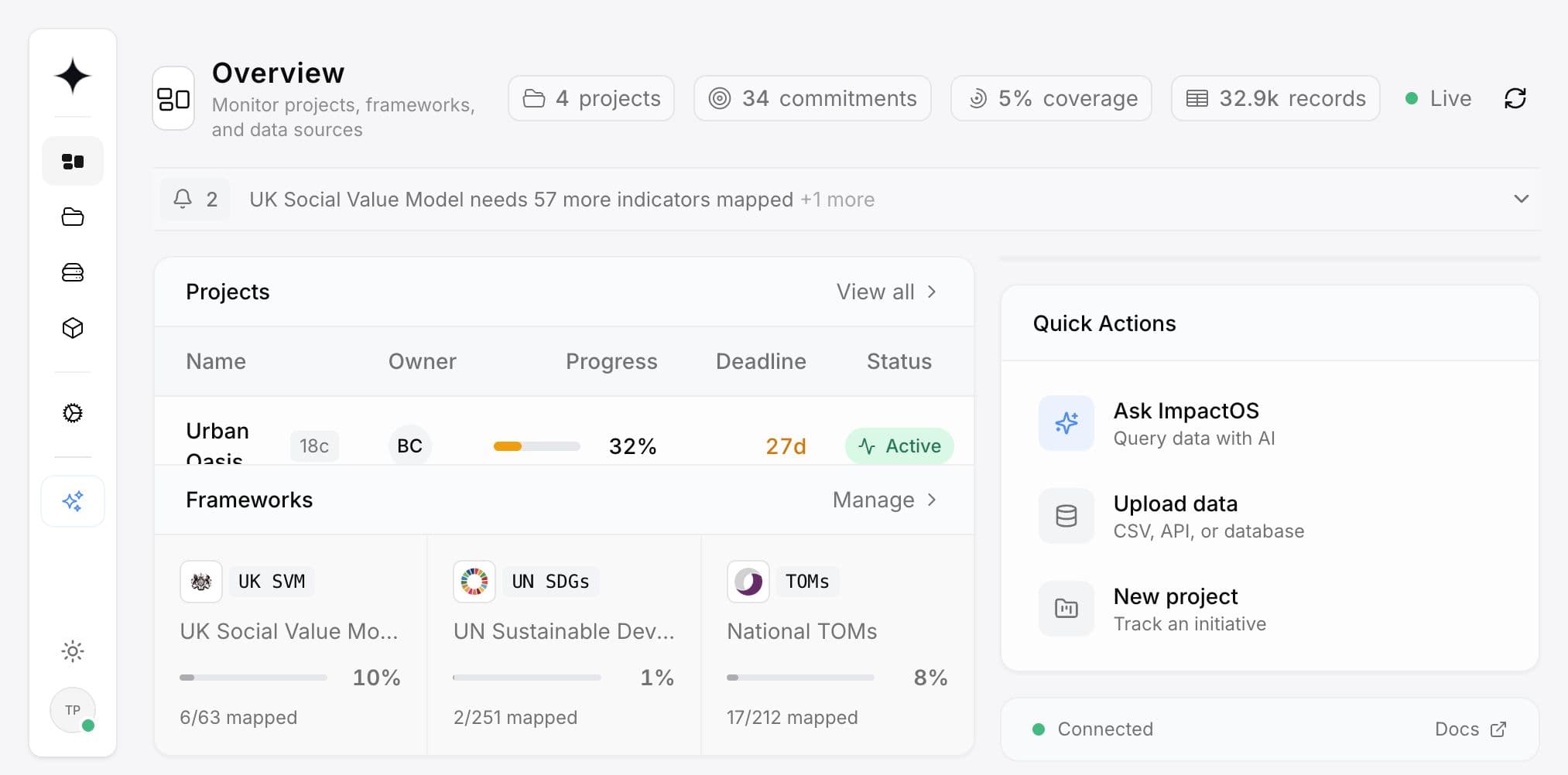
The 90-day plan above is achievable manually. ImpactOS exists to make it structural and repeatable.
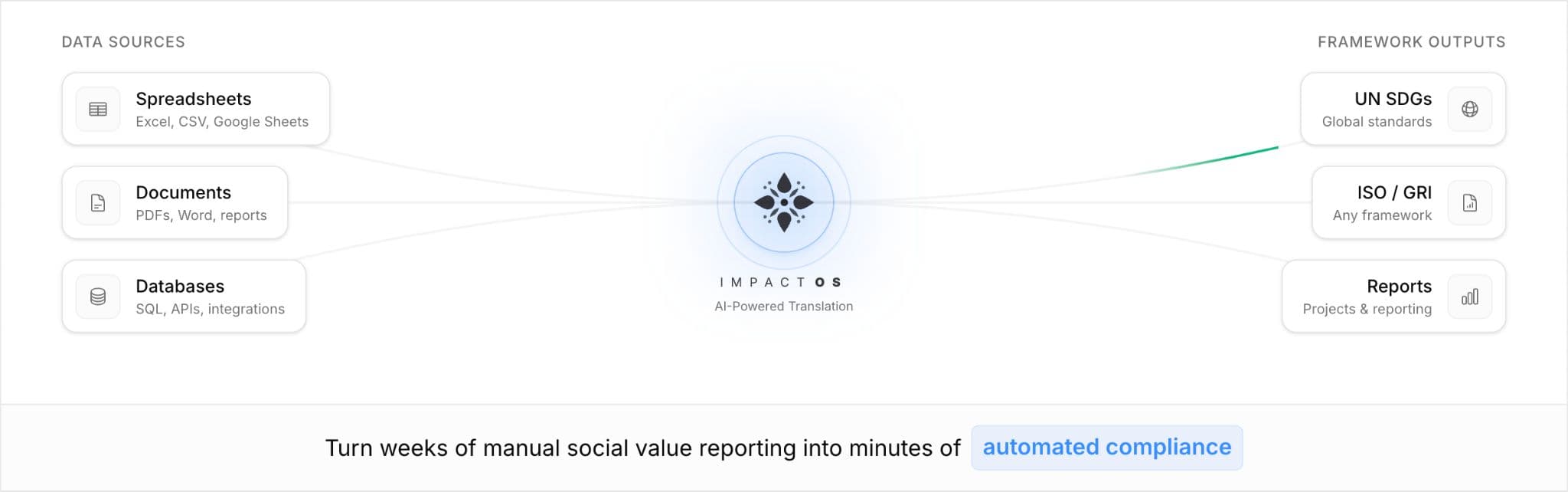
ImpactOS is a data transformation and translation engine. It takes the scattered evidence that organisations already have — documents, system exports, spreadsheets, supplier responses — and structures it into a durable evidence model that can be mapped into whichever framework a stakeholder requires: UK Social Value Model, SECR, CSRD/ESRS, CDP, UN SDGs, TOMs, or custom buyer, supplier and partner frameworks.
The platform is already in use with design partners ranging from multi-billion to single-million-pound organisations, with signed customer contracts in place from Q2 2026.
If your organisation is feeling the weight of Evidence Debt, the question is not whether to act. The question is whether you keep adding headcount and consultants to a manual process, or whether you invest in the evidence infrastructure that makes the problem structurally smaller.
Four capabilities matter:
- Traceability. Every claim in every output links back to source. “Show your workings” is a query, not a project.
- Continuous translation. When a framework updates, or when a new stakeholder asks for evidence in a different structure, existing evidence is re-mapped rather than rebuilt. This is what Level six on the Evidence Curve looks like in practice: framework change becomes a configuration issue, not a compliance crisis.
- Commitment-to-delivery linkage. What was promised at bid stage is connected to what is being delivered during the contract. Contract managers, procurement evaluators and boards get a live view of social value performance — not a retrospective narrative assembled under pressure.
- A reusable evidence spine. Structure evidence once; use it across tenders, reports, due diligence responses and stakeholder updates. The efficiency gain is real, but it is a consequence of doing evidence properly, not the headline.
Conclusion
Social value is moving from narrative to proof. The evidence burden is rising. Scrutiny is rising. Budgets and delivery capacity are not rising with them.
That gap is Evidence Debt, and it is a commercial problem. It slows revenue access, increases audit friction, creates uncertainty in diligence conversations and undermines credibility at the moments that matter most.
The organisations that win will not be those with the boldest commitments. They will be those that treat social value as an evidence operating model. Building a reusable evidence spine, proving delivery across the contract lifecycle and adapting as standards change.
The question is no longer “what should we say?” It is: “Can we prove it? And can we deliver it?”
Ready to pressure-test ImpactOS?
james@impactos.tech www.impactos.tech